

VLT refers to the percentage of visible light that passes through the lens. It not only determines how dark the lens appears, but also directly affects your visual experience in different environments.
A simple way to understand it:
- Lower VLT → Less light enters the eye → Stronger shading
- Higher VLT → Brighter vision → More visual clarity
However, “darker is better” is not always true.
If the lens is too dark, it may reduce visibility in certain situations and even create safety risks.
Visible Light Transmission (VLT)
1. VLT Categories (International Standard)
According to international standards, sunglasses lenses are typically divided into five categories:
| Category | VLT | Lens Characteristics | Suitable Scenarios |
| Cat. 0 | 80%–100% | Almost clear / very light tint | Indoor, night use, fashion |
| Cat. 1 | 43%–80% | Light tint, mild shading | Cloudy days, light outdoor use, commuting |
| Cat. 2 | 18%–43% | Balanced shading and clarity | Daily wear, shopping, travel |
| Cat. 3 | 8%–18% | High shading, most common | Beach, driving, outdoor activities |
| Cat. 4 | 3%–8% | Very high shading | Mountains, snow, extreme sunlight |
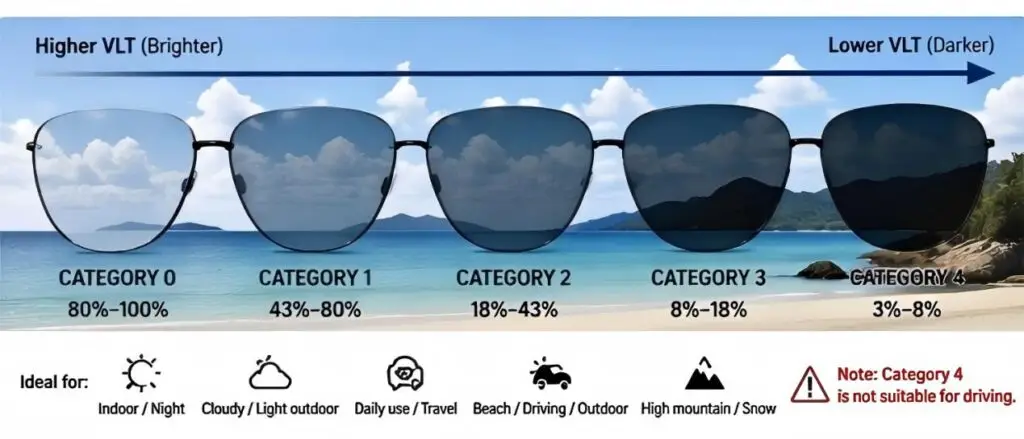
⚠ Note: Category 4 lenses are not suitable for driving due to reduced visibility.
2. How to Choose the Right VLT?
Choosing the right VLT is not about picking the darkest option—it’s about selecting what fits your specific usage.
A practical way to decide is by considering three factors:
- Environment (light intensity)
- Duration (how long you wear them)
- Visual demand (clarity and color recognition)
a. Daily Wear — Cat. 2 or Cat. 3
This is the most common use case, including commuting, shopping, or casual outings.
Why choose Cat. 2 or 3:
- Effectively reduces everyday sunlight
- Maintains natural brightness
- Comfortable for long-term wear
✔ Tip: Grey or green lenses are recommended for more natural color perception.
b. Beach / Strong UV Environments — Cat. 3 or Cat. 4
At the beach, light is not only strong—it’s also highly reflective.
Water surfaces reflect sunlight, creating additional glare and visual discomfort.
Cat. 3 or 4 lenses help:
- Reduce light intensity
- Minimize glare
- Improve visual stability
c. Sports & Outdoor Activities — Cat. 3
For sports, stability matters more than just darkness.
During activities like cycling, hiking, or running, your eyes constantly adjust to changing light conditions.
Cat. 3 lenses provide:
- Consistent shading
- Reduced eye fatigue
- Better visual response
✔ Suggested pairing:
- PC or nylon lenses (lightweight & impact-resistant)
- Stable lens structures for enhanced safety
d. Fashion / Light Use — Cat. 1 or Light Tint
In these scenarios, style matters more than performance.
Suitable for:
- Photography
- Styling / outfits
- Indoor-outdoor transitions
✔ Light or gradient lenses can enhance visual appeal while maintaining basic comfort.
3. Product Positioning (Industry Perspective)
a. Building a Structured Product Matrix
From a product development perspective, VLT is not just a technical parameter—it is a key tool for structuring your product line. A well-balanced assortment should be built around different VLT categories to cover various use cases and price levels:
| Product Type | Recommended Configuration | Purpose |
| Core Styles | Cat. 3 | Covers the widest audience |
| Daily Comfort | Cat. 2 | Enhances wearability |
| Fashion Styles | Cat. 1 / Gradient | Adds design variety |
| Performance Styles | Cat. 3 | Targets outdoor niches |
This structure helps brands cover different user needs while maintaining a clear product strategy.
a. Building a Structured Product Matrix
Beyond product structure, preferences for VLT can vary significantly across different markets. Understanding these differences allows for more targeted and effective product recommendations.
- European & American Markets
Prefer Category 3
These markets place strong emphasis on functionality. Glare reduction and visual clarity are key priorities, making polarization almost a standard expectation. - Middle East & High Sunlight Regions
Prefer Category 3 or Category 4 lenses
Due to intense sunlight and high UV exposure, consumers in these regions are more sensitive to shading performance and tend to favor darker lenses. - Fashion & Design-Oriented Brands
Prefer Category 1, gradient, or light-tinted lenses
In these segments, lenses are part of the overall design language. Visual aesthetics often take priority over technical performance.
4. Summary
VLT may seem like a simple number, but it defines the core performance of sunglasses:
- How comfortable they feel
- How clearly you see
- How safe they are to use
Instead of choosing the darkest lens, the smarter approach is to choose the right VLT for the right situation.